
Azerbaijan Traveller Sheki
Plan your visit to Sheki Khan’s Palace in Azerbaijan with opening hours, ticket prices and a floor plan. Then follow six rooms from the officials’ waiting room to shebeke windows and painted dragons that breathe flowers.
01 / Before you go
Tickets, opening hours and directions
Sheki Khan’s Palace (Şəki xan sarayı, also called the Palace of Shaki Khans) stands inside Sheki Fortress in the Yukhari Bash reserve. Allow about 40 minutes for the courtyard and the six rooms, plus time to buy tickets or wait for your group.
- Find the palace. Open Sheki Khan’s Palace in Google Maps.
- Tickets and hours. The palace is open from 9:00 am to 6:00 pm. Admission is 15 AZN for foreign visitors. Optional private guiding costs an additional 10 AZN; ask at the ticket desk about availability. Check the palace ticket listing for your date.
- Inside the palace. All six rooms are open to visitors. Staff admit visitors in small groups to avoid crowding. Photography is not allowed inside.
- Steps and thresholds. The route includes a second floor and raised thresholds. Ask staff about access before buying a ticket if steps are a concern.

Why the palace matters
After a destructive mud flood in 1772, Sheki’s historic centre was rebuilt on higher ground. The city’s silk trade helps explain the wealth you see in the palace and old merchant houses. UNESCO listed the historic centre together with the palace in 2019. Read the UNESCO listing.
Think of the eighteenth-century palace as a summer seat of government and ceremony rather than an ordinary home. The exact construction date and patronage are debated. The rooms offer a way into that history: waiting, deliberation and writing below; reception rooms and the khan’s traditionally identified private office upstairs.
02 / The walk
Palace floor plan and self-guided route
The room names below follow local guiding practice. Treat the room uses and the meanings of the paintings as traditional readings where noted. Follow staff directions if the route on the day differs.
Upper floor · Level 2
Ground floor · Level 1
Dashed lines show passages. Enter from the courtyard on the right-hand side of the plan, then follow stops 1–6 in order.
Outside first
The courtyard and façade
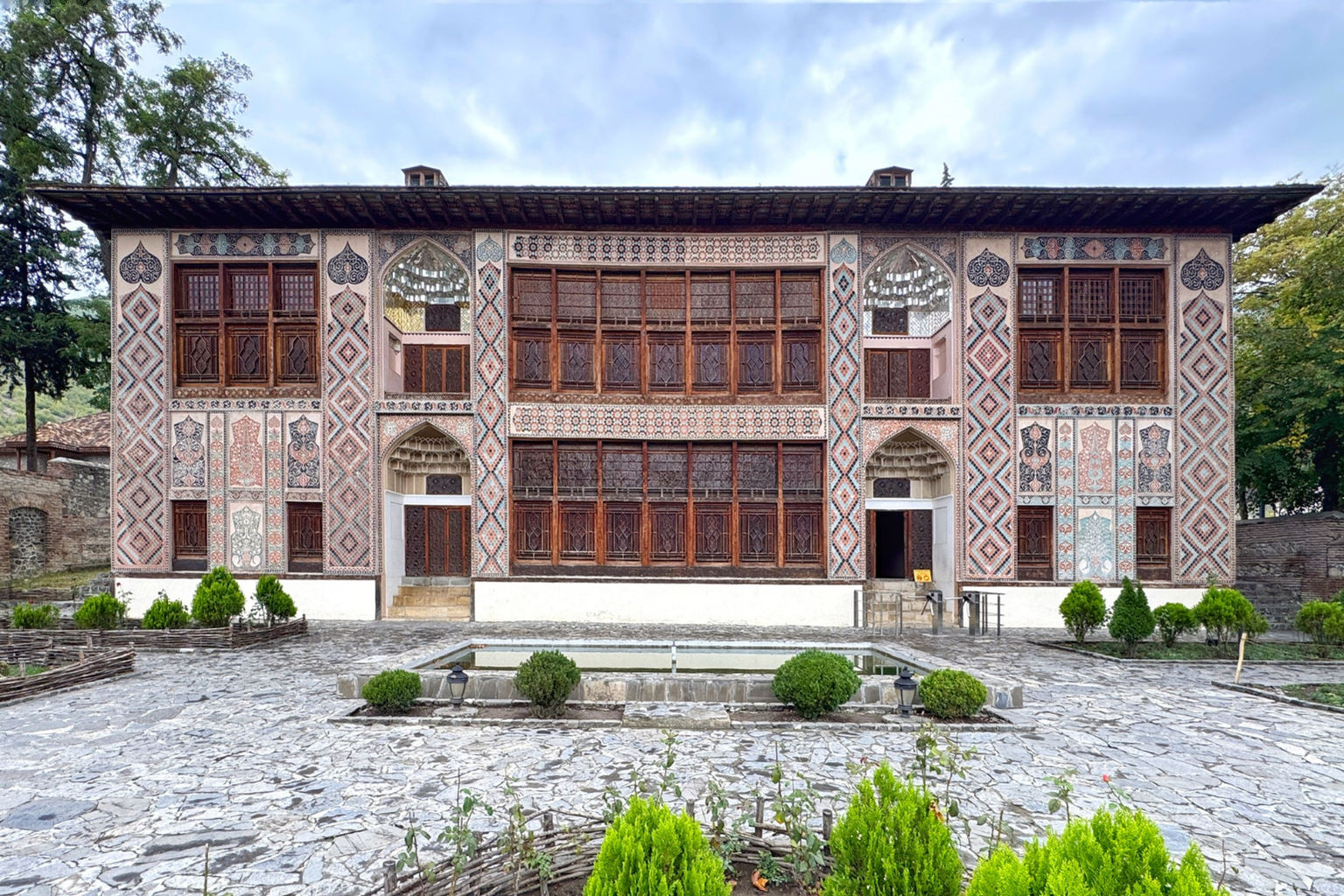
Start in the shade of the old plane trees. Azerbaijan’s tourism board describes them as around 500 years old; local tradition gives 1530 as the planting year, but take that as tradition rather than a confirmed date. From under the canopy, step back until you can see the balance of the façade. Find the two recessed balconies and their mirrored, stalactite-like ornament, known as muqarnas.
Look for: Peacocks flanking a Tree of Life. You can read the tree as a symbol of growth and renewal. Then pick out one patch of shebeke (şəbəkə): tiny pieces of coloured glass held in a precise wooden lattice without nails or glue in the lattice itself. From outside you see the geometry; from inside the coloured light is the point.
Start here: Facing the palace from the courtyard, use the main entrance on the right-hand side.
Ground floor Waiting, decisions and records
Room 01 · Just after the main entrance
Officials’ waiting room
Just inside the main entrance, turn right into the waiting room. It is traditionally identified as the place where officials or visitors waited for an audience with the khan. It’s a useful pause before the decorated halls: in a court, who got to pass through the next doorway mattered.
Look for: How the room leads you toward the next space. Imagine arriving with a request and having to wait before you could make it.
Room 02 · Ground floor
The Divankhana, or council chamber
Return to the entrance passage. The Divankhana is on the left as you face in from the main entrance. This central hall is traditionally associated with consultation and decisions. Picture advisers seated low on carpets and cushions rather than at a long table. Local guides place the khan near the fountain, facing the fireplace-like niche known as the bukhari. Its exact use here is uncertain; ventilation is one local explanation.
Look for: Take a moment to examine the ceiling and the stained-glass shebeke windows. Follow the pattern where the coloured glass meets the wooden lattice. According to local guides, a single elaborate panel can contain up to 14,000 interlocking pieces of wood and glass.
Then look for the fountain, the glazing above it, the small wall ledges associated with lamps or candles, and the raised thresholds. The thresholds are often explained as a way to limit draughts at floor level.
Room 03 · Ground floor
The chancery
Leave the Divankhana on the far side and cross the corridor to the chancery, or dəftərxana. In the traditional account, this is where scribes turned decisions into correspondence and official documents. Its comparatively plain walls make a striking contrast with the chamber you just left.
Look for: Lower niches traditionally associated with papers and writing materials, and higher ones associated with lighting. Compare the ceiling height with the Divankhana: local guides put the difference at about 60 centimetres, an approximate figure.
Go upstairs: Turn left as you leave the chancery, then left again to reach the stairs to the upper floor.
Upper floor Reception, stories and symbols
Room 04 · Upper floor
The khan’s wife’s reception room
At the top of the stairs, turn right into the room traditionally associated with the khan’s wife. It is usually described as a place to receive guests and conduct the social business of the court, not as a bedroom. After the lower rooms, the flowers, birds and garden motifs give it a more intimate feel.
Look for: How the ceiling and walls work together. Local guides say a patterned carpet once echoed the ceiling design. It’s an evocative way to picture the furnished room, not a verified reconstruction.
Room 05 · Upper floor
The guest hall
Return to the upstairs landing. The guest hall is to the left as you arrive at the top of the stairs, opposite the reception room. This central hall is often presented as the setting for formal receptions and, in local accounts, poetry gatherings. Muhammad Husayn Khan wrote under the pen name Müştaq. Picture guests seated on carpets and cushions, with cylindrical bolsters (mütəkkə) kept in the storage spaces between gatherings.
Look for: The narrow painted bands high on the walls. Start by finding a racing animal or a mounted figure before trying to read the whole scene.
Five scenes to look for in the frieze
- A wounded leopard and a gazelle hunt.
- A deer hunt.
- A battle with a dragon.
- A hunt involving a one-horned creature.
- Cavalry led by a figure read as a young commander.
These are local scene identifications. Don’t assume that a painted rider or battle depicts a specific historical person or event.
Room 06 · Upper floor
The khan’s private office
Continue through the guest hall and across the next passage to the room traditionally identified as the khan’s private office. Try looking at the animals before reading a meaning into them. A dragon breathing flowers rather than fire is a good starting point. One local reading sees strength tempered by mercy: power can protect as well as destroy.
Look for: A lion attacking a goat, then wolves and goats sharing a scene. Read together, the pair offers a question: what changes when the vulnerable are allowed to live without fear?
More motifs and a line to remember
Local guides read the peacock as a reminder that even beauty has flaws. A lion confronting a dragon can suggest opposing forces, and the crowned, winged lion with a woman’s face and a sword can suggest authority and wisdom. These are interpretations, not evidence of the khan’s personal beliefs.
Ask a guide about the medallion inscription. In one local transcription, its sense is: I will not remain; this will remain as a remembrance. The exact wording and attribution should be checked against the inscription.
Return to the courtyard: Turn right as you leave the private room and take the stairs down.
03 / Back outside
What to see after the palace
Before leaving the courtyard, turn back and look at the windows once more. What you saw inside reflects generations of work: the palace’s paintings and decoration have been repaired or restored in successive campaigns, including during the Russian imperial and Soviet periods.
Continue to a shebeke workshop to see how the pieces fit, or head down to the Upper Caravanserai for another side of Sheki’s trading history. Check access separately. Stopping for lunch? Read our guide to eating Sheki-style piti. Azerbaijan Travel’s Sheki overview has more places to visit around the fortress.
04 / Quick answers
Common questions
Can I visit Sheki Khan’s Palace without hiring a private guide?
Yes. Staff admit visitors in small groups whether or not they hire a private guide. You can use this article to prepare or follow along with your group; private guiding is optional.
How much time should I set aside?
About 40 minutes is a suggested pace for the courtyard and rooms combined, not a timed ticket or a promise of time inside. Add time for tickets and waiting, and plan separately for the rest of the fortress.
Is this the same place as the Shekikhanovs’ House?
No. This guide covers the Khan’s Palace inside the fortress. The Shekikhanovs’ House is a separate historic building in Sheki.